Navigate

October 19, 2012

Kids' willpower influenced by others' reliability

Think back to your childhood Halloween: 9pm, a school night, pillowcase full of candy.

Just as you plunge into your pile of peanut butter cups, fun size this-and-thats, and spider rings (weren't they so exciting?), Mom ruins the party. "You can eat three. Then go brush your teeth and get ready for bed."

Did you eat just three? Or did you sneak an extra Baby Ruth or two when she wasn't looking?

A study published earlier this month in Cognition suggests that willpower is not the only factor in play when it comes to foregoing that extra piece.

Instead, a child's belief about their superiors' reliability can change their willingness to wait for a better payoff later.

October 9, 2012

Facebook-stalking your ex; or, how NOT to move on

Do you have an ex?

Do you have a Facebook profile? Does your ex?

Do you stalk your ex on Facebook?

To the untrained eye, that photo of him eating dinner with...that girl...at Olive Garden is no big deal. But Olive Garden was our place, and—wait, is that the watch I got him? Oh, and it looks like he got into that grad school he wanted to go to. The one for which I edited his personal statement and quizzed him with GRE words...

Ugh.

I'm going to tell you something that you probably already know: you should stop doing this. And I'm armed with the psychology of why it's bad!

September 16, 2012

Sight without seeing: Bálint's syndrome

Scientific literature is, to say the least, pretty dull.

It's rife with redundant phrases, confusing methodologies, and tiny graphs. Reading page after page of long words in small font is better than any over-the-counter sleep aid out there for getting the job done.

Occasionally, the rare gem will come along just when you least expect it, providing a readable (dare I say—enjoyable) account of the latest research.

So begins a paper published this past week in Neurology:

"It was a quiet Thursday afternoon when 'A.S.', a 68-year-old woman from a suburb of Chicago, awakened from a nap to the realization that something was terribly wrong."

What?! What's wrong! Must...keep...reading...

As the article continues, we learn how A.S. and another patient, J.D., adjust to their lives before and after their diagnoses of Bálint's syndrome.

August 28, 2012

Catnip fever: Why your cat acts high

There are few things in this world more entertaining than cats. Except for, perhaps, cats on catnip.

Yes, "on" catnip. I speak of it like a drug, because it is.

Sure, make a laser pointer dance around the room and you've got endless hours of entertainment. But give Mittens a little toy mouse infused with catnip and—well, something changes.

Mittens will rub against the toy, rolling around and ecstatically chewing it. She may drool and become either sleepy or anxious. If you try to take the toy, she might act aggressive, scratching or biting at you.

Forget the mouse—Mittens wants the catnip inside. So what is catnip, and why is it causing your sweet kitty to behave so dichotomously?

August 13, 2012

"Gaines, on Brains" turns 1!

It was a year ago today—around this time of day, too—that I was sitting in my apartment at my new school, not quite sure how to spend my first weekend in this strange new town. My laundry was done, I'd already gotten groceries, and I didn't know anybody from orientation well enough to see if they wanted to go to Chocolate World with me.

I remember munching on a sandwich when it suddenly clicked that my last name rhymes with "brains" (why didn't I realize this before?!), and thus I quickly began making my science writing dreams a reality by creating this blog.

Today "Gaines, on Brains" turns 1, and what a year it's been! I've since started science blogs with LabSpacesPennLive, and my latest work-in-progress, Psychology Today magazine. My writing has been featured during my stint as a guest blogger for Scientopia, I've been linked by MSNBC, and was interviewed for the Scientific American Incubator Blog. I've been asked to attend special local events, write up press releases, and I even had the opportunity to interview psychic medium John Edward (believe his claims or not, it was an interesting experience).

But most importantly, this blog has allowed me to interact with so many interesting, insightful, thoughtful, and questioning readers—scientists and non-scientists alike—which is exactly how I envisioned my audience when I set out to write about the latest neuroscience research and hot topics.

And so, readers, I ask you for a small birthday gift. In the tradition of science writer Ed Yong and the SciAm Blog Network that just turned 1 last month, I want to know—who are you?

Whether you openly follow my blog or whether you lurk quietly, I'd love for you to tell me a bit about yourself and why you read this blog in the comments section below:

Who are you?
What is your relationship to science?
What drew you to this blog, and how often do you read it?
Do you follow the blog on Twitter and Facebook?
How am I doing? What do you like, and how can I improve?

These questions are a guide, not a strict format—write as much or as little as you want. 

I truly appreciate the feedback and opportunities I've received from everybody this past year, and I thank you all for your support and encouragement—as both a writer and a student. Stay neurosciencey!

August 1, 2012

Paralyze your face, fight depression

I'm willing to bet you've made fun of the expression-less faces on heavily-Botoxed people.

With their vanished crow's feet, missing smile lines, lack of forehead wrinkles, and paralyzed cheeks, eventually we just can't tell whether Botox abusers are happy, sad, angry, worried, or just plain crazy. We can only assume the latter.

As it turns out, this side effect may actually be a good thing for individuals with depression who are resistant to other forms of treatment.

July 23, 2012

Superhero science: tapping into our super-strength with adrenaline

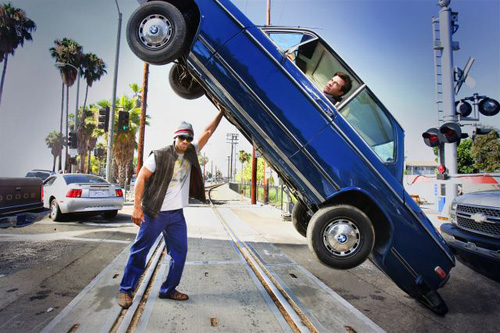
In 1982, Angela Cavallo of Lawrenceville, Georgia received the Mom of the Year Award. (Not a real award, but if it existed, she would probably win, hands down). Her son Tony was working on the suspension of his 1964 Chevy Impala when the car suddenly slipped off the jack and pinned him in the wheel well.

Angela dashed outside to see her unconscious son trapped under the car. She yelled for a neighbor to get help but it was taking too long, so she took matters into her own hands. Literally. She proceeded to lift the car—high enough to replace the jacks—and pull Tony out from beneath.

Yep, you read that correctly. She lifted a 3,500-pound car from the ground.

There's not much more information to be found about Mrs. Cavallo aside from this incredible story, but I'll safely assume she wasn't a body builder. In fact, I'll bet the same for the other individuals who have also demonstrated this sort of "hysterical strength." But that's beside the point—if you were placed in a similar situation, you could probably lift a car, too!

It's all thanks to the handy little hormone called adrenaline.

July 13, 2012

Chronic blushing: When it goes beyond embarrassment

A teacher calls on you when your hand isn't raised, and you feel the familiar sensation as your classmate's eyes immediately dart toward you. Mrs. So-and-So watches expectantly, smirking. A surge of blood races from your gut to your head and your cheeks become warm. Hot. A sheepish smile involuntarily follows. You know you're bright red, and that embarrasses you even more.

Everyone knows what it feels like to blush—whether from embarrassment, emotional stress, or even just receiving a compliment. Perhaps worse than the act itself is knowing that everyone else can see the physical manifestation of your discomfort, which inconveniently functions to further redden your face.

But for 5-7% of the population, blushing is a chronic problem—happening both more frequently and with greater magnitude than the average person. Physically, it's rather harmless—but psychologically, it can be devastating.

In late May, Brandon Thomas, a 20-year-old University of Washington student, committed suicide by jumping from his 11-story dorm. "I am tired of blushing," read his suicide note. "It is exhausting to wake up everyday and have to find little ways to avoid blushing situations."

June 30, 2012

Turning trauma into story: The benefits of journaling

For me personally, June has proven to be a rather disappointing and fruitless month. Just when things began to look brighter, I was involuntarily assigned to be the middle vehicle in a double fender-bender two days ago, and my car now needs almost $1,000-worth of repairs. And as a perfect metaphor for the crappiness of the past month, for whatever reason I was not paid my stipend yesterday for the month of June.

I don't often like to talk about my sour feelings with other people because a.) I'm bad at it, and b.) I have another outlet.

Everyday for the past 12 years (save for a few angsty months in 8th grade), I've been writing in a journal. A good, old-fashioned, hardbound, acid-free journal. Most entries are about the frivolous happenings of the day at school, but as I've gotten older, they've increasingly helped me outline my thoughts and feelings while keeping my head on straight.

Feeling so low, I journaled the night before my car accident, listing ten qualities I liked about myself. Remembering what I wrote as I spent the next day at the body shop and on the phone with the police and insurance companies is, I believe, what kept me from simply bursting into tears and throwing up my hands in defeat.

Writing, as many would probably agree, is therapeutic, and studies in the past two decades have explored the health consequences of secrets, expressive language, and the before-and-after physical and psychological symptoms associated with trauma—an area of research referred to as "writing therapy."

June 15, 2012

Ecstasy: "Safe"?

Call me a prude, but I'm not so thrilled about the announcement made yesterday by British Columbia's top health official that ecstasy is "safe."

Dr. Perry Kendall asserted yesterday that the health risks of 3,4-methylenedioxymethamphetamine—or MDMA, the active ingredient in the drug ecstasy—are exaggerated, and that pure ecstasy is not dangerous when consumed responsibly by adults.

Its lethal dangers arise, he says, when gangs pollute the drug with other chemicals.

I'm not sure when the notion came into play that anything which doesn't kill you automatically means its "safe," but I would like to respectfully debunk Dr. Kendall's remarks with a very powerful and striking study published 13 years ago.

June 7, 2012

Narcolepsy: More than just falling asleep on the job

Check out this short video of "Rusty the Narcoleptic Dog." I was first introduced to Rusty in a video presented to my high school psychology class. As expected in a classroom full of teenagers, we erupted into a fit of laughter when the happy-go-lucky dachshund suddenly collapsed into a deep sleep:


Gallup polls reveal that 56% of Americans complain that daytime drowsiness is a problem in their lives, the majority of which is caused by sleep deprivation. A controlled, objective scientific study once revealed that 34% of participants were considered "dangerously sleepy," even when they didn't complain about daytime sleepiness.

America is a sleepy country—but narcolepsy takes it to a whole new level. Imagine feelings of exhaustion at all times, accompanied by inappropriate sleep attacks. Sure, falling asleep on the job is embarrassing and unprofessional, but also imagine the danger of a narcoleptic attack while driving. What is narcolepsy, and what causes this mysterious disorder?

June 4, 2012

Award + more great science blogs!

This afternoon, after a particularly frustrating drive back to PA from a weekend home (seriously, y'all have been doing road construction for the past year!), I checked my e-mail to see that I'd been nominated for the Kreativ Blogger award by fellow science writer Sarah Jane Alger ("Miss Behavior") over at The Scorpion and the Frog.

It's been so exciting to see my blog grow and develop since last summer, so to be recognized by a fellow science blogger is very meaningful for me. Thanks Sarah Jane!

The award works in a pay-it-forward fashion. I'm now to 1.) Thank the giver and link their blog (check!), 2.) List seven things that my readers may not know about me, and 3.) Award it to seven other blogs.