Navigate

April 27, 2015

Can Wearing Orange-Tinted Glasses before Bed Improve Sleep? Only One Way to Find Out...

I recently wrote about the terrible sleep habits of the characters in House of Cards. I disapproved of Frank Underwood’s late-night computer work in the Oval Office, his new midnight iPad gaming habit, and Claire taking her laptop to bed with her.

But I must confess my hypocrisy.

Despite my preaching – and despite being a sleep researcher myself – the last thing I do before I flip off the lights and snuggle into my bedsheets is play games on my iPhone.

I know, I’m bad – but I also know I’m not the only guilty person here.

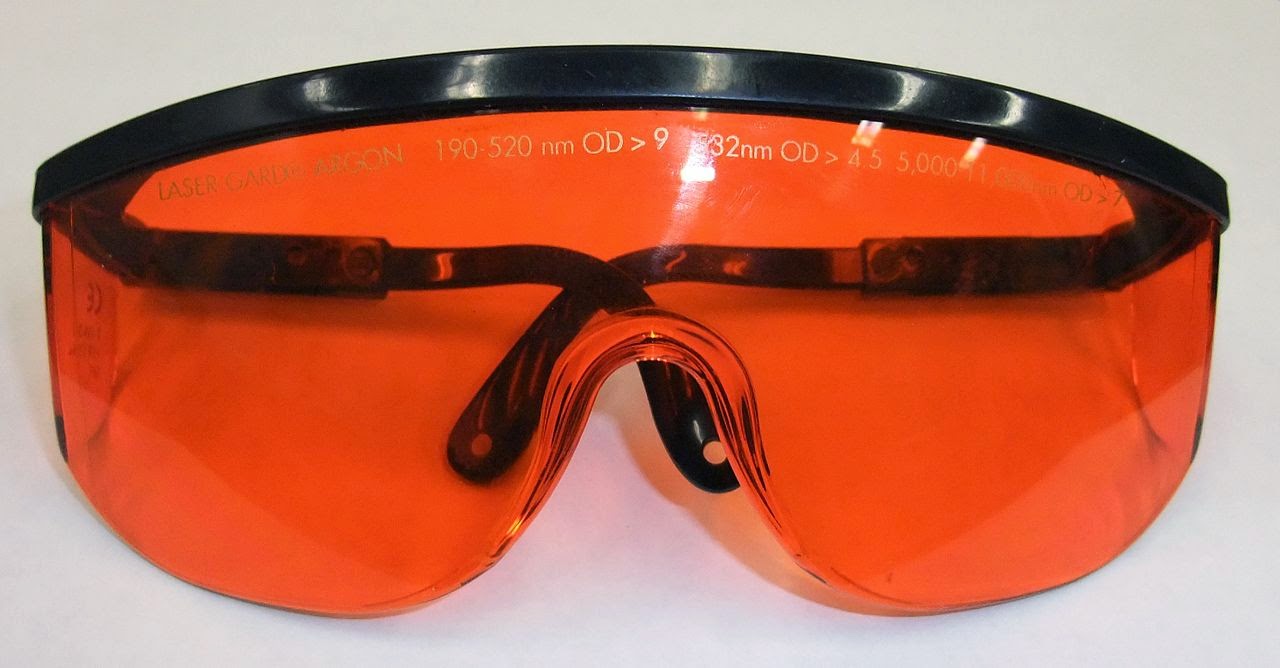
Chhe (Wikimedia Commons)
Although evidence suggests that the blue light emanating from phones, tablets, laptops, televisions and e-readers can affect the quality of our sleep – in turn affecting our health and well-being – many of us can’t help logging in and tapping away when we should be winding down. A Time/Qualcomm poll of 5,000 people worldwide suggests that nearly a quarter of those between the ages of 18 and 24 generally don’t sleep as well because of technology. Even worse, 40-75% of folks across all age groups report keeping their phones within reach while they sleep at night.

But there might be a solution. Earlier this month, orange-tinted glasses, or “blue blockers,” were touted by the New York Times as a good option for those who simply can’t avoid technology before bed.

As a concerned scientist, I decided to do an experiment on myself. I hopped onto Amazon, bought an $8 pair of orange glasses, and formulated my research plan. Without changing any of my other habits, would wearing these glasses an hour before bed improve the quality of my sleep?

April 9, 2015

Why Does Hodor Keep Hodor-ing? Neuroscience Explains

Giphy
Hodor hodor hodor. Hodor hodor? Hodor. Hodor-hodor. Hodor!

Oh, um, excuse me. Did you catch what I said?

Giphy
Fans of the hit HBO show Game of Thrones, the fifth season of which premieres this Sunday, know what I’m referencing, anyway. Hodor is the brawny, simple-minded stableboy of the Stark family in Winterfell. His defining characteristic, of course, is that he only speaks a single word: “Hodor.”

But those who read the A Song of Ice and Fire book series by George R R Martin may know something that the TV fans don’t: his name isn’t actually Hodor. According to his great-grandmother Old Nan, his real name is Walder. “No one knew where ‘Hodor’ had come from,” she says, “but when he started saying it, they started calling him by it. It was the only word he had.”

Whether he intended it or not, Martin created a character who is a textbook example of someone with a neurological condition called expressive aphasia.

March 5, 2015

The House of Cards Characters Have Terrible Sleep Hygiene

It’s entirely possible that I’ve been staying up too late this week. After leaving the lab at the end of the day, I’ll head home to binge on the political drama House of Cards, the third season of which was dumped onto our Netflix queues last Friday.

They'd be better off just going to bed. (Tumblr)
Simultaneously, the National Sleep Foundation is also sponsoring Sleep Awareness Week from March 2nd to 8th, which makes me feel guilty for how poor my sleep hygiene has been lately. But perhaps I shouldn’t be too hard on myself—after all, I’m not the Leader of the Free World who needs to make rational, clear-headed decisions about my country on a daily basis.

Since the first episode of the show, I’ve been pretty appalled by the Underwoods’ poor sleep habits. In the spirit of Sleep Awareness Week, here are three simple sleep hygiene rules that Frank and Claire would be wise to follow.

February 18, 2015

This is Your Brain When You Give Up Sugar for Lent

Can you resist? (Shuttershock)
Anyone who knows me also knows that I have a huge sweet tooth.

I always have. My friend and fellow graduate student Andrew is equally afflicted, and living in Hershey, Pennsylvania—the “Chocolate Capital of the World”—doesn’t help either of us.

But Andrew is braver than I am. Last year, he gave up sweets for Lent.

Are you abstaining from sweets for Lent this year, too? Here’s what you can expect over the next 40 days.

February 10, 2015

How an ADHD Drug Works to Combat Binge-Eating

Maria Raquel Cochez (Wikimedia Commons)
Last Friday, the U.S. Food & Drug Administration approved the use of lisdexamfetamine dimesylate for treatment of binge-eating disorder. Licensed under the brand name Vyvanse, lisdexamfetamine is the first and only FDA-approved medication for this condition.

But Vyvanse has already been on the market since 2007 for once-daily usage in attention deficit hyperactivity disorder (ADHD) in children and adults.

How does this drug act on two seemingly distinct conditions?

January 30, 2015

3 Ways Being a Science Communicator has Made Me a Better Scientist

Hold still while I place the electrodes on your head!
My first research presentation in college is forever etched into my memory.

It was the end of our fall semester biology lab, and my group met in the library the week beforehand to prepare our PowerPoint. I was in charge of making slides with background information.

For our project, my lab group had measured polyphenol oxidase—an enzyme involved in the browning of fruit—in three different apple varieties.  As it turns out, every group had done this experiment. It was the coolest thing we’d learned how to do that semester, after all.

So I wanted our group to stand out. I interspersed the boring, informational slides with a little storytelling, and the experiment took on a life of its own:

It’s almost time for the annual county fair, and you want to make the best apple pie! You know that the key to success is using an apple that won’t brown right after you cut it. Which variety will get you the blue ribbon?

My group was a bit skeptical, but they ultimately buckled under my persistence.

We got our grade a week later—an A. But the professor wrote a note underneath: “Good presentation, but a bit gimmicky. Don’t do that next time.”

I was deflated. While my approach, in retrospect, may not have been the best for a class assignment, I knew that what I had done wasn’t inherently bad or wrong—I was telling a story.

Scientists are often told to reach out to general audiences about their research for the public’s benefit. We need to establish trust! Taxpayers deserve to understand where their money is going! We need to clear up misconceptions about GMOs and vaccines and climate change!

While these arguments are absolutely true, many scientists find this hard to do. Science communication can become a time-consuming side job. And for many, such a responsibility to the general public can be extremely daunting.

But it’s okay for scientists to practice their communication skills for non-philanthropic reasons, too. Despite my initial college lab experience, telling stories as a science communicator today has made me a much, much better scientist in a few unexpected ways.

December 9, 2014

Colin Firth and the Slippery Slope of Scientific Authorship

Colin Firth CBE...PhD? Nicogenin (Flickr)
I’ve been in research for about seven years now. But if you search my name in PubMed, precisely one scientific paper will pop up—a manuscript published this past spring from my current group. I’m pretty far down on the author list, which reflects my contribution relative to my colleagues on this particular paper. While I helped with some of the writing, the data collection and most of the analyses were performed by others.

As you snuggle by the fire this holiday season to watch Love Actually, you should know that you’re also viewing the work of a published academic neuroscientist. That’s right—another PubMed search reveals that actor Colin Firth is cited on a 2011 brain imaging study in the journal Current Biology. 

And it doesn’t take an insecure graduate student like me to accuse Mr. Firth of not pulling all-nighters in the laboratory.

Authorship in science is tricky. In some laboratories, it’s a bit of a taboo topic. Ask your average scientist if they’ve witnessed abuses in authorship, and they’ll likely be brimming with stories for you—from people being “gifted” an authorship they don’t truly deserve, to hard-working (often junior) scientists being wrongly shafted by their colleagues. These stories are rarely discussed among labmates, and almost never between junior and senior investigators.

And then there are the extremes, like the 2001 Nature paper on the sequencing of the human genome boasting 2,900 authors and the 2012 paper detailing the Higgs boson, which cites a whopping 3,171 co-authors. Where exactly do we draw the line between who has made a meaningful contribution to a project and who is better suited for the “Acknowledgments” section?

November 28, 2014

Exposure to Different Forms of Violence Affects Kids’ Sleep Differently

I have a guest post today with the British Psychological Society's Research Digest blog. The piece is based on a new study in the journal Sleep Medicine showing that children exposed to different forms of violence in their community are plagued with different types of disturbed sleep.
Two particular types of violence stood out to researchers in terms of their association with sleep disturbance. Controlling for relevant confounders (such as age, gender and family income), individuals who were physically assaulted had a shortened sleep duration (by 35 minutes on average), exhibited almost three times as much wake time after sleep onset, and 6 per cent lower sleep efficiency than kids who did not experience physical assault. These effects were also seen three months later at follow-up. 
On the other hand, children who witnessed a homicide had twice as much wake time after sleep onset, greater night-to-night variability in sleep duration, and more self-reported sleep problems than kids who had not witnessed a homicide. These findings, however, did not persist at follow-up.
Read more of the post here!

November 20, 2014

#SfN14 Day 5: Reflections on a Neuroscient-astic Week

This is the final post in my series on the 2014 Society for Neuroscience annual meeting. It's been fun! You can read other posts in this series here. I live-tweeted some sessions @GainesOnBrains. Re-live the experience by exploring the hashtag #SfN14.
Taking some time away from the hubbub (and
warmth, apparently) to sightsee.

What a week. Neuroscience 2014 was completely overwhelming, exhausting, inspiring, invigorating, and fruitful (I'm kind of sad that last one didn't end in "-ing"):

  • There were over 30,500 people in attendance on any given day, with over 15,000 abstracts presented as posters or oral presentations.
  • I don't think I attended a single talk that didn't have a line of latecomers waiting to get in.
  • ...and I saw Eric-freaking-Kandel strolling around casually in his signature bowtie while I sat on the steps waiting to meet some friends for dinner.

But I think my biggest "takeaways" from the meeting weren't necessarily from the scientific sessions. There is so, so much more that goes on behind the scenes at scientific conferences, and thanks to its titanic proportions, Neuroscience 2014 was certainly no exception.

Here are 3 things I learned from #SfN14:

#SfN14 Day 4: “It’s Not the Stress that Kills Us; It’s Our Reaction to It” –Hans Selye (Theme E)

This post is part of my series on the 2014 Society for Neuroscience annual meeting. You can read other posts in this series here. I’m also live-tweeting some sessions @GainesOnBrains. Join the conversation at #SfN14.

Day 4 winding down. You wanna know what a stressful situation is?
Being surrounded by 30,500+ people for five days. Whew!
For the most part, I like to think I handle stressful situations fairly well. I take a few deep breaths, tell myself the stressor is really not that big of a deal, then go find something else to do—like exercise or knitting.

The fact of the matter still holds, though: I’m a ruminator. As much as I try to escape, I can’t stop thinking about it if something’s bothering me. It affects my attention, what I eat, and how I sleep, to name a few.

The worst part is that all of this rumination is probably terrible for my cardiovascular health in the long-run. I try to adopt my positive coping mechanisms…but am I actually doomed?

Susan K. Wood of the University of South Carolina spoke on the role of stress and neuroinflammation in not only the susceptibility to depressive symptoms, but also how these symptoms translate to risks for cardiovascular disease. Wood was one of several speakers on Tuesday’s symposium focusing on resilience to stress.

November 18, 2014

#SfN14 Day 3: How to Effectively Communicate Your Science to the Public

This post is part of my series on the 2014 Society for Neuroscience annual meeting. You can read other posts in this series here. I’m also live-tweeting some sessions @GainesOnBrains. Join the conversation at #SfN14.

My positively GORGEOUS new cell scarf from Artologica (Michele Banks)!
Check out her Etsy store for this and other incredible art!
Talk about exhaustion. I didn’t get a chance to write yesterday because I was too busy meeting Internet friends at #sfnbanter. In case anyone was wondering, all the people on Twitter are real!

In sleep research, we have this term called “social jetlag.” It’s aptly named. I’m feelin’ it big time this morning.

Yesterday morning, I attended the professional development workshop called “How to Effectively Communicate Your Science to the Public.” Panelists included science communicator Elaine Snell, AAAS Director of Public Engagement Tiffany Lohwater, author Jane Nevins, and Columbia University professor and NeuWrite host Stuart Firestein.

Here are some tips and tricks that particularly stood out to me:

November 16, 2014

#SfN14 Day 2: On the Origin of Sex Differences in the Brain (Theme E)

This post is part of my series on the 2014 Society for Neuroscience annual meeting. You can read other posts in this series here. I’m also live-tweeting some sessions @GainesOnBrains. Join the conversation at #SfN14.

This is what a bunch of hungry neuroscientists look
like when it's 5pm and the poster session is over.
One of my mentors likes to occasionally tease me when I bring him data: “You’ve discovered something new. Men and women are different.”

He kids, of course. Male and female brains are different in funny and fascinating ways we don’t quite understand.  My poster (which I presented this afternoon) was on gender differences in the loss of slow-wave sleep across adolescence. I just had a paper accepted (today, actually!) on gender differences in some aspects of sleep apnea. (I could actually probably build a pretty successful career on studying gender differences in sleep alone, actually. If I wanted to.)

So I was very excited to attend Dr. Margaret (Peg) McCarthy’s talk on the origin of sex differences in the brain earlier this afternoon.

Let me get two things out of the way before I begin. First of all, I really admired Dr. McCarthy, who hails from the University of Maryland School of Medicine, for how she spoke about her past and present colleagues, giving credit where credit was due to previous labmates and graduate students. You don’t realize how few people do that until someone does it explicitly.

Secondly, McCarthy covered the history of research in sex differences in the most genius way possible: a parody of The Big Bang Theory theme song. Seriously—it was golden.

The simplistic view of biological sex differences goes a little something like this: an undifferentiated group of cells destined to become the gonads will, by default, be ovaries. But it’s the influence of the Y chromosome that gives half of our population testes. In this way, too, the “female brain” is the “default brain.”